
Design, build, and deploy computer vision solutions with OpenCV
Oodles designs and deploys production-ready computer vision systems built on OpenCV. Our teams use OpenCV with Python and C++, integrating deep learning models from TensorFlow and PyTorch to deliver high-performance image and video analytics with seamless enterprise integrations.
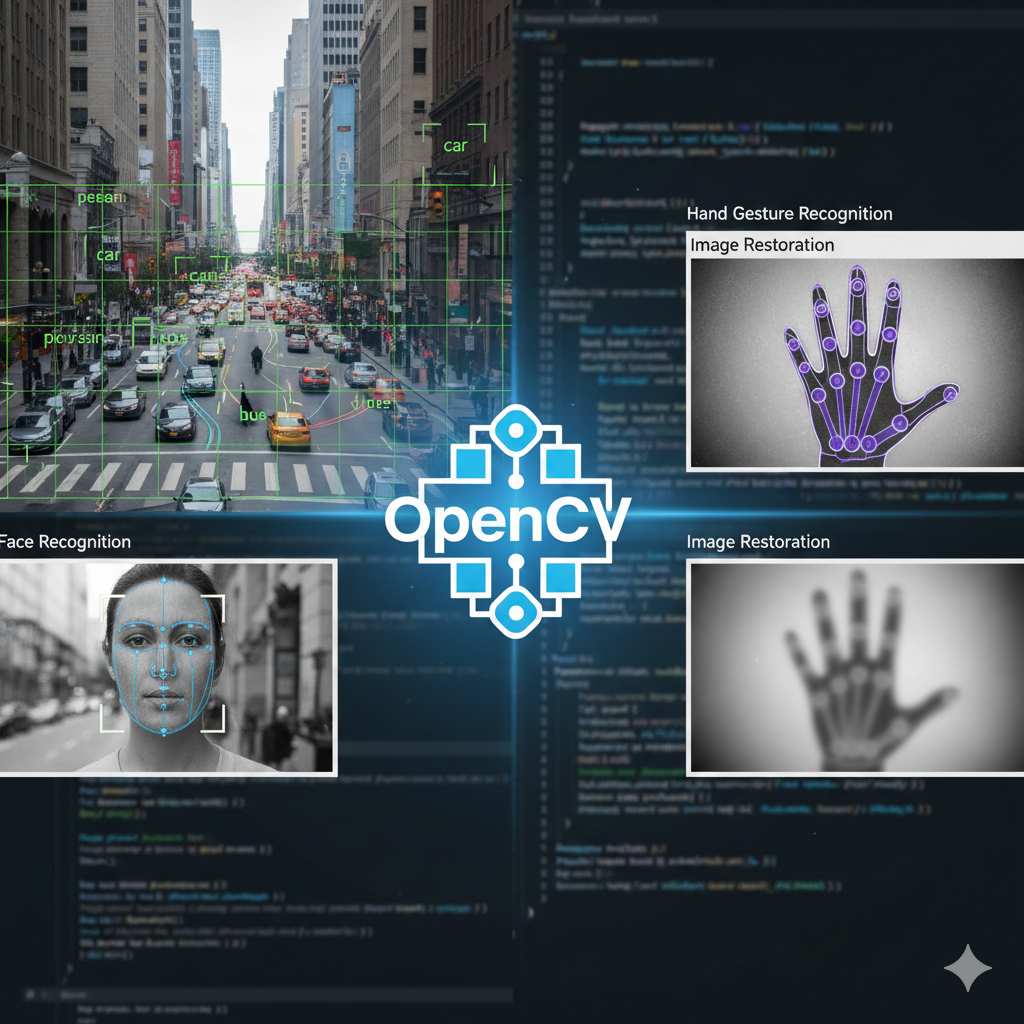
What is OpenCV?
OpenCV (Open Source Computer Vision Library) is an open-source framework for real-time computer vision. It provides optimized APIs for image processing, video analysis, feature detection, tracking, and seamless integration with machine learning and deep learning models.
What we deliver with OpenCV
Image Processing
Image preprocessing, filtering, geometric transformations, feature extraction, and enhancement using OpenCV’s optimized image processing modules.
Object Detection & Tracking
Real-time object detection and tracking pipelines using OpenCV with classical methods (Haar cascades, HOG) and deep learning model inference integration.
Video Analysis
Video stream processing, motion detection, background subtraction, stabilization, and frame-level analytics built with OpenCV.
ML Integration
OpenCV integration with TensorFlow, PyTorch, and ONNX models for deploying deep learning–powered vision workflows.
Optimization & Deployment
Performance tuning with OpenCV, hardware acceleration using CUDA, and deployment across Linux, Windows, embedded, and edge platforms.
Custom Tools
Custom OpenCV-based tooling for robotics vision, medical imaging, industrial inspection, and real-time monitoring systems.
Our Methodology
Our OpenCV-driven delivery model focuses on designing, building, and optimizing computer vision pipelines that meet real-time performance and accuracy requirements.
1
Discover: Assess visual data, camera inputs, hardware constraints, and performance goals for OpenCV-based pipelines.
2
Design: Select OpenCV algorithms, preprocessing steps, and deep learning model integrations.
3
Build: Implement OpenCV pipelines, validate accuracy, and integrate with edge, IoT, or cloud systems.
4
Optimize: Tune OpenCV performance, enable hardware acceleration, and scale for production workloads.
High‑Impact Use Cases
Surveillance Systems
OpenCV-powered real-time video analytics, object detection, and motion tracking for surveillance systems.
Medical Imaging
Image preprocessing, segmentation support, and feature extraction using OpenCV for diagnostic workflows.
Retail Analytics
Customer movement analysis, shelf monitoring, and footfall analytics built on OpenCV video pipelines.
Autonomous Vehicles
Lane detection, obstacle detection, and traffic sign recognition using OpenCV-based perception modules.
Quality Control
OpenCV-driven defect detection, dimensional measurement, and automated inspection on production lines.
AR/VR Applications
Marker tracking, pose estimation, and real-time overlays implemented with OpenCV.
Why OpenCV?
OpenCV provides a highly optimized, cross-platform computer vision library designed for real-time image and video processing with strong support for hardware acceleration and AI model integration.
Real-Time Processing
Optimized with fast algorithms and hardware acceleration for live, high-performance applications.
Extensive Integrations
Fully compatible with Python, C++, Java, and AI frameworks such as TensorFlow and PyTorch.
Industry Applications
Widely used in healthcare, automotive, robotics, and retail for reliable vision-based automation.
Open-Source Flexibility
Free, customizable, and supported by a strong global community under the BSD license.
FAQs (Frequently Asked Questions)
OpenCV provides robust libraries for image processing, object detection, feature extraction, and video analytics, enabling scalable and high-performance computer vision applications.
OpenCV supports real-time image filtering, edge detection, motion tracking, facial recognition, and object tracking optimized for GPU acceleration and edge deployment.
OpenCV integrates with TensorFlow, PyTorch, and ONNX models to preprocess images, run inference, and optimize AI-driven computer vision pipelines.
Manufacturing, healthcare, automotive, retail, and security sectors use OpenCV for quality inspection, medical imaging, surveillance, and intelligent automation.
Performance optimization includes multithreading, GPU acceleration, efficient memory management, and model compression for scalable production deployments.
OpenCV supports deployment on edge devices, embedded systems, and IoT platforms for low-latency, real-time computer vision processing.
OpenCV development improves automation accuracy, reduces manual inspection costs, enhances operational efficiency, and accelerates AI-powered digital transformation.
Ready to build with OpenCV? Let's get in touch







We are ISO 9001:2015 Certified
Connect with us


Follow us